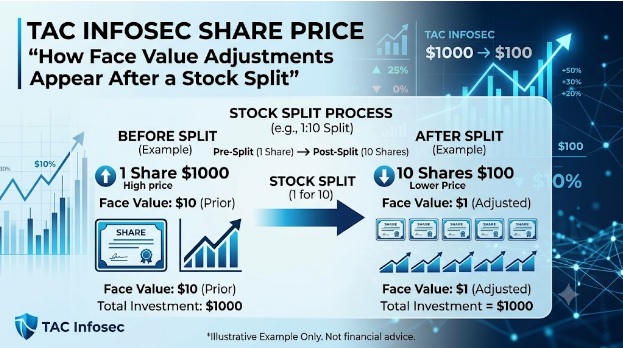
When investors track the TAC Infosec share price, they may come across corporate-action details such as face value, bonus issues, stock splits, record dates, and adjusted prices. Understanding these terms is important because a stock split can change the face value and number of shares held without directly changing the overall value of an investor’s holding immediately after the adjustment. Face value is the nominal value assigned to each equity share by the company and is different from the market price at which the share trades on an exchange. TAC Infosec’s equity shares have a face value of ₹10, according to its public filings and exchange disclosures.
Ways in Which Value Adjustments Appear After Stock Split
A stock split occurs when a company divides one existing share into multiple shares. For example, if a company with a ₹10 face value announces a 1:2 split, one ₹10 share may be divided into two shares with a face value of ₹5 each.
1] Valuation of Shares:
The number of shares held by an investor increases, while the face value per share decreases proportionately. The market price is also adjusted to reflect the higher number of shares, subject to normal market movements. Therefore, investors should not interpret a lower post-split share price as an automatic loss in value. The adjustment is primarily a change in the share structure.
2] Split the Ratio:
For TAC Infosec share price tracking, it is particularly important to distinguish a stock split from a bonus issue. NSE’s corporate-action information shows TAC Infosec had a 1:1 bonus issue with an ex-date of October 15, 2025, while the face value was listed as ₹10. A 1:1 bonus issue means eligible shareholders receive one additional share for every one share held, but it does not by itself reduce the face value from ₹10 to ₹5. This distinction can prevent confusion when reviewing historical TAC Infosec share price data.
3] Financial Website Tracking:
After a genuine stock split, financial websites and exchange records may display the revised face value alongside the adjusted share price. Historical price charts and per-share financial figures can also be adjusted to make comparisons across periods more meaningful. Investors reviewing older TAC Infosec share price data should therefore check whether a particular adjustment resulted from a stock split, bonus issue, rights issue or another corporate action.
4] Ensure Market Price:
The face value itself should not be confused with the market value of TAC Infosec shares. Market price is determined by trading activity and investor demand, whereas face value is an accounting and corporate-structure figure. A change in face value following a stock split does not, by itself, indicate a change in the company’s underlying business value.
Conclusion
Therefore, while analysing the TAC Infosec share price, investors should examine the corporate-action history before comparing prices from different periods. Checking the face value, split ratio, bonus ratio, ex-date and adjusted historical prices can help investors understand why the number displayed on a stock page may differ from older records. This approach provides a clearer picture of price history and prevents stock-split or bonus adjustments from being mistaken for actual gains or losses.
About the Author